

Author: Site Editor Publish Time: 2026-06-09 Origin: Site
In commercial kitchens, high-density apartments, and cold chain logistics facilities, precise appliance placement is essential. However, facility managers often find that refrigerator locations do not align with pre-installed wall outlets. When a refrigeration unit stands feet away from a primary power source, using an extension line becomes an immediate operational necessity.

However, selecting an incorrect extension cord introduces severe hazards. In professional environments, using a substandard power connection risks heavy machinery damage, electrical fires, and safety non-compliance, which can void commercial insurance property claims. Refrigerator units function as a heavy-duty continuous load with demanding startup power requirements, making standard domestic cords highly dangerous.
Can you use an extension wire for a refrigerator? Yes—but only under strict engineering constraints. This professional technical guide outlines the precise physical and electrical criteria needed to select the correct power link, ensuring operational safety, municipal regulatory compliance, and equipment durability.
Determining what size extension cord for refrigerator operations requires understanding core electrical concepts: wire cross-section, current capacity, and voltage drop across distances. Unlike small electronics, a refrigerator utilizes a motorized compressor that requires robust power delivery.
In the American Wire Gauge (AWG) system, a smaller gauge number signifies a larger copper conductor diameter, lower internal resistance, and higher current capacity. For standard distances under 25 feet, a 14 AWG conductor is the minimum benchmark for refrigeration equipment. For longer runs up to 50 feet or high-capacity commercial models, a heavy-duty 12 AWG or 10 AWG conductor is mandatory.
The table below summarizes the technical thresholds required for safe refrigeration loads:
Wire Gauge (AWG) | Conductor Section Area | Maximum Current Rating | Application Appropriateness |
10 AWG | 5.26 mm² | 30 Amps | Industrial walk-in coolers and extended distances up to 100 feet. |
12 AWG | 3.31 mm² | 20 Amps | Heavy-duty commercial refrigerators and laboratory freezers (Up to 50 ft). |
14 AWG | 2.08 mm² | 15 Amps | Standard commercial breakroom or residential appliances (Under 25 ft). |
16 AWG | 1.31 mm² | 13 Amps | STRICTLY PROHIBITED. High risk of severe voltage drop and insulation melting. |
Using a common 16 AWG utility cord triggers a severe voltage drop. Because thin wires possess high linear resistance, the voltage reaching the motor drops below its operational threshold during startup. This starvation forces the compressor motor to draw higher current, creating excessive thermal stress that quickly burns out the motor windings.
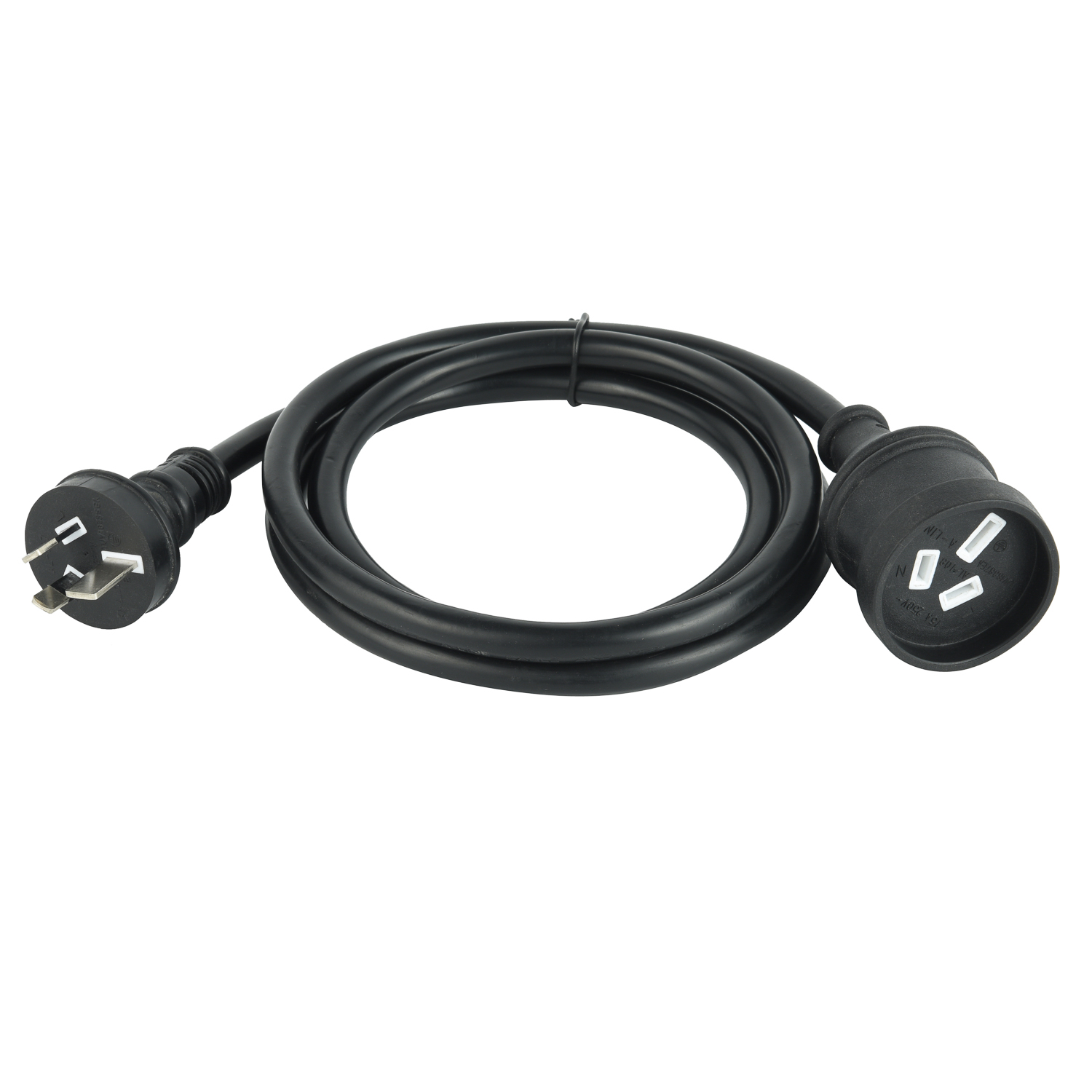
A-Line Cable SAA PVC Extension Cord
When evaluating what extension cord to use with refrigerator units, both steady-state running current and transient inrush current must be balanced. While a commercial refrigerator may draw 5 to 8 Amps continuously, the moment the cooling cycle starts, the compressor requires a massive surge of startup power—known as Locked Rotor Amps (LRA)—which can reach 3 to 5 times the running current.
To provide a safe electrical cushion, engineers apply a 125% safety factor for continuous inductive loads:
Total Required Cord Amperage = Running Amperage × 1.25 + Startup Surge Headroom
Consequently, any power cord deployed for commercial refrigeration must be rated for at least 15 Amps to 20 Amps. This structural headroom ensures the copper conductor manages localized thermal loads during compressor startup without material fatigue.

A-Line Cable AC Power Extension Cord 16A 125V
Refrigerators feature large metallic chassis and operate around high-density moisture, making them prone to ground faults. It is a fundamental safety violation to connect a refrigerator to anything other than a dedicated three-prong grounding plug. The grounding prong provides a safe path of least resistance for stray electrical currents, ensuring that any internal short circuit trips the breaker rather than electrocuting staff. Two-prong adapters or splitters are strictly prohibited in professional facilities.
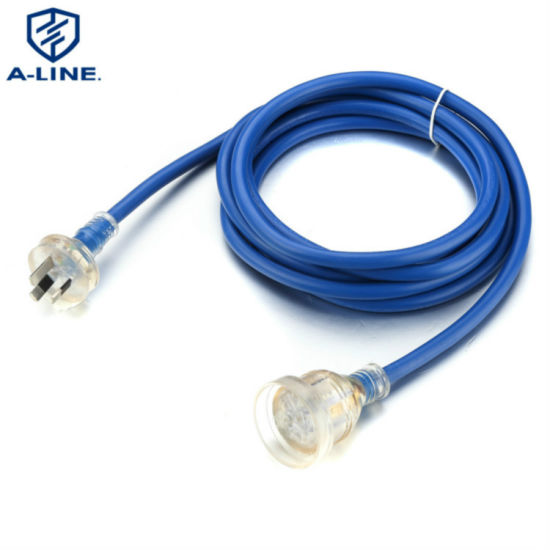
A-Line Cable 3 Pin Power Plug 3 Prongs Extension Cord
Deploying undersized temporary wiring for refrigeration leads to predictable equipment failure and safety hazards in commercial facilities.
The compressor is the heart of the refrigeration unit. An inadequate, high-resistance power cable causes a voltage drop that starves the compressor motor of the torque necessary to spin up efficiently. This delay elongates the high-current startup phase, generating extreme heat within the motor windings. Over time, this repetitive thermal cycling breaks down the delicate enamel insulation coating the copper windings, causing internal short circuits and permanent compressor failure.
Unlike intermittent household electronics, a refrigerator functions as a continuous load that remains active 24/7. When current flows continuously through an undersized copper conductor, the inherent electrical resistance generates constant thermal energy. Because thin cables lack adequate cross-sectional area to dissipate this heat, the cable temperature rises steadily, melting through PVC insulation jackets and leading to direct short circuits or structural fires.
In commercial and industrial settings, workplace safety is heavily regulated. Under US OSHA Standard 1910.305, extension cords are restricted to temporary use and are explicitly barred as a permanent substitute for fixed structural wiring. Local municipal fire marshals enforce equivalent mandates. Finding an uncertified, improperly rated wire feeding a primary commercial asset triggers substantial financial penalties. Furthermore, if an unapproved line causes a fire, commercial insurance underwriters have legal grounds to deny property damage and liability claims.
When sourcing electrical components for corporate, industrial, or medical refrigeration infrastructure, procurement teams should follow this strict safety and material checklist:
Verifiable Regulatory Certifications: Ensure the wire assembly carries legitimate safety stamps molded directly into the insulation jacket or plug heads. Look for internationally recognized marks such as UL (North America), VDE / CE (Europe), SAA / RCM (Australia/NZ), or CCC / TUV / ASTA (Global Markets).
Jacket Compound Selection: For commercial environments, select SJTW Insulation (Junior Hard Service, rated for 300V, thermoplastic with weather and moisture resistance) for kitchens and wet environments. Alternatively, choose SPT-3 Insulation (heavy-duty integrated thermoplastic surface cord) for thick, crush-resistant insulation behind heavy appliances.
Length Optimization: In electrical wiring, conductor length is directly proportional to resistance. Always buy the shortest length required to minimize impedance and voltage drop. Avoid coiling excess length of a high-current wire, as this traps heat and accelerates insulation breakdown.
Connection Stability: Choose lines engineered with heavy-duty over-molded plug heads, reinforced strain reliefs, and integrated mechanical locking mechanisms or tight-tolerance contact blades to prevent accidental disconnection and dangerous electrical arcing.
Sourcing unverified retail cables for large-scale corporate infrastructure introduces unacceptable operational risk. A-Line Cable delivers high-performance, precision-engineered power transmission infrastructure tailored specifically for global B2B procurement.
Standard off-the-shelf cables often fail to satisfy specialized industrial layouts. A-Line Cable offers comprehensive, client-specific manufacturing configurations. Procurement partners can specify exact linear lengths to eliminate coiled excess, select precise AWG structural profiles (10 AWG, 12 AWG, or 14 AWG), and choose tailored insulation compounds (including SJTW and SPT-3) to match specific hardware requirements.
At A-Line Cable, safety is integrated into our core manufacturing process. Our production facilities are fully certified under the ISO 9001:2015 Quality Management System. Our heavy-duty extension lines and custom wire harnesses carry top-tier international safety certifications, including UL, VDE, SAA, CCC, RCM, ASTA, TUV, CE, and meet strict RoHS/REACH environmental directives. Sourcing from A-Line Cable guarantees that your facilities satisfy strict fire codes and pass insurance risk assessments.


We structure our operations to support high-volume B2B distributors, international wholesalers, and commercial project managers. We provide optimized minimum order quantity (MOQ) structures and reliable delivery schedules. Additionally, our advanced OEM and ODM services allow clients to integrate custom corporate branding, specialized molded plug designs, and unique safety protection directly into production. Partner with A-Line Cable to secure your commercial power infrastructure with direct-from-manufacturer efficiency.