Publish Time: 2026-05-21 Origin: Site
In industrial plants and commercial buildings, power cords are far more than simple conductors for electricity—they are the cornerstone of system safety, operational stability, and energy efficiency. Selecting the wrong type of power cord can lead to equipment malfunctions, unplanned downtime, and severe fire hazards. So understanding global power cord standards, technical specifications, and application‑specific requirements is essential for buyers to make accurate, compliant purchasing decisions.
This guide breaks down power cord classifications by connector standards, cable materials, and operating environments, helping B2B buyers identify the ideal power cord for their industrial and commercial projects.
Plug and connector are the key link between power cords, devices, and sockets. They define voltage, amperage, and regional compatibility, making them the primary identifier for different power cord types.
High‑purity copper is the standard conductor material. The cross‑sectional area (AWG gauge) determines the cord' s current‑carrying capacity, a critical factor for high‑power industrial applications. Low‑quality conductors cause excessive heat, voltage drop, and safety risks.
Insulation prevents electric leakage and short circuits. The outer jacket delivers protection against abrasion, oil, extreme temperatures, and aging, adapting the cord to harsh indoor, outdoor, and industrial environments.
VDE Approved PVC Insulated 10A C13 C14 Connector Power Cord
Two dominant global standards govern commercial and industrial power cords: IEC 60320 (international) and NEMA (North American). Each standard serves distinct regional markets and application scenarios.
IEC 60320 is the internationally accepted standard for power cord appliances and it is widely adopted for IT infrastructure, data centers, and network equipment worldwide.
C13/C14 and C19/C20: The global industry standard for servers, switches, PDUs, and network hardware. C13/C14 is designed for medium‑load IT devices, while the higher‑capacity C19/C20 serves high‑power servers, industrial PDUs, and large UPS systems.
SAA IEC C19 C20 Connect Extension Cord
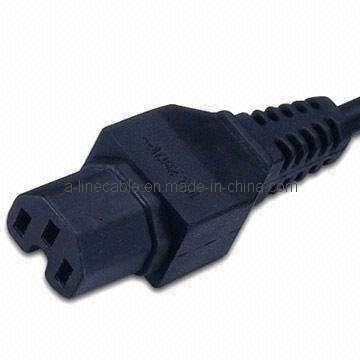
C15/C16: Specially designed for high‑heat environments such as enclosed server cabinets and industrial high‑temperature machinery, featuring flame‑retardant and heat‑resistant properties to prevent thermal degradation.
Appliance-Connector-C15-120-Degree-AL
NEMA is an ANSI accredited standard for the configuration of electrical receptacles, cord voltage capacities, and plug types in North America.
5-15P and 5-20P: The baseline standard for North American offices and light‑to‑medium industrial equipment. 5‑15P (15A) is suitable for office appliances and small machinery; 5‑20P (20A) supports high‑power commercial equipment and mid‑size industrial machine tools.
Us-Waterproof-5-15p-125V-3-Pin
Locking Power Cords: Engineered for B2B applications exposed to vibration or accidental disconnection. The locking mechanism secures the plug firmly in place, preventing unexpected power loss for heavy‑duty machine tools, mobile industrial equipment, and outdoor engineering machinery.
AWG (American Wire Gauge) measures conductor thickness: the lower the AWG number, the thicker the copper wire and the higher the current‑carrying capacity.
High‑power equipment such as large motors, heating systems, and industrial machine tools requires low‑AWG heavy‑gauge cords. Undersized wiring causes overheating and voltage drop, damaging equipment and creating safety hazards. Buyers must match AWG ratings to equipment power requirements using official load charts.
Jacket materials dictate durability and environmental suitability, with standardized letter codes for different protection grades.
S, SJ, ST, SVT Series: Differentiated by flexibility and durability. SVT is lightweight and flexible for general indoor use; SJ offers superior abrasion resistance for frequently moved equipment; ST provides high heat and aging resistance for continuous use in hot workshops.
O, W Series (Oil or Weather Resistance): “O” denotes oil resistance for factory workshops and chemical plants; “W” indicates weatherproofing for outdoor exposure to rain, sunlight, and humidity, ideal for construction and field‑based applications.
For buyers, regulatory compliance is a non‑negotiable requirement for customs clearance and project acceptance. Customization enables tailored solutions for specialized industry needs.
UL and CSA certification are mandatory for the North American market, while CE and VDE compliance are required for the EU and global markets. Certified power cords eliminate customs risks, ensure project approval, and guarantee long‑term operational safety.
A‑Line Cable provides full‑range B2B customization services, including custom cut‑to‑length production, specialized terminations (stripping, tinning, custom connectors), and customized colors or branding printing. These solutions simplify inventory management for distributors and meet unique requirements across data centers, industrial manufacturing, medical equipment, and outdoor engineering projects.
15m SAA Australian15A Heavy Duty Extension
Choose manufacturers that use premium raw materials for conductors, insulation, and jackets, with strict production quality control aligned with international standards.
B2B orders often involve large‑volume and customized requirements. Prioritize suppliers with large‑scale production capabilities and sufficient stock to avoid project delays.
A trusted supplier provides end‑to‑end technical support, including specification selection guidance, compliance certification review, and on‑site troubleshooting to mitigate procurement risks.
Though often overlooked as a minor component, the power cord is a critical factor in protecting equipment safety, maximizing operational efficiency, and reducing long‑term maintenance costs.
A-Line Cable specializes in power cords designed for the rigors of commercial use. From certified safety compliance to custom inventory solutions, we help you build reliable power setups for every project.